GPT-6 Astra
what is confirmed, what users say, and what to test
A source-led look at GPT-6 Astra: official features and API pricing, contrasting developer reactions, and a practical checklist before using it for client work.
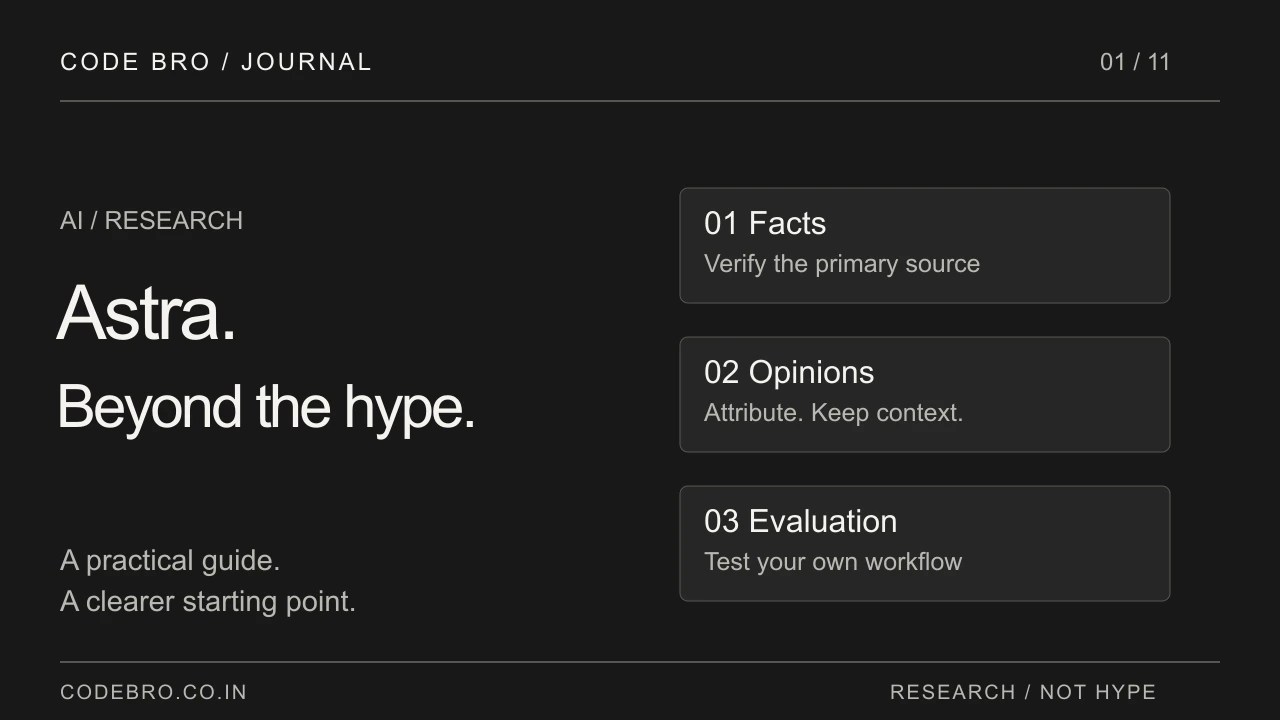
AI-assisted source research and drafting. Research credit does not imply personal testing or completed human review. Editorial policy
What is GPT-6 Astra?
GPT-6 Astra is the official model name; its API identifier is gpt-6-astra. OpenAI positions it for demanding reasoning, coding, computer use, research and document work. That positioning is a vendor description, not an independent Code Bro benchmark.
If you arrived after seeing “Astra 6” in a post, the useful question is not whether a demo looks impressive. It is whether the model can complete your kind of work, within your constraints, at an acceptable total cost. This article separates documented features, a small sample of public reactions and our suggested evaluation approach.
The confirmed specifications, without the hype
The model page lists a 1,050,000-token context window and a maximum output of 128,000 tokens. It accepts text and image inputs and produces text; direct audio and video are not listed as supported modalities. Those input/output limits are not a guarantee of reliable recall or correct work across an entire large project.
A bigger context budget can make it easier to supply relevant material. Our advice is still to select the files, requirements and examples that matter. Giving an assistant a larger pile of information does not tell it which business rule should win when two documents disagree.
What changes in a working AI application?
OpenAI’s guide describes asynchronous tool calling: the model can continue other work while an application executes a tool. It also documents mid-turn steering, where additional instructions can be incorporated during a task, and changing reasoning effort while preserving cache. Developers still own tool execution, permissions and pending-work handling.
Our interpretation: these features make the surrounding workflow worth evaluating, not just the final answer. In a booking product, for example, retrieving availability and preparing an explanation can be independent steps. Actually confirming a booking must still wait for valid availability, user approval and a successful server response. A model capability is not a replacement for that application logic.
How much does GPT-6 Astra cost?
At this research check, standard API text pricing is US$10 per million input tokens and US$50 per million output tokens; cached input is US$1 per million. Cache writes are listed at US$12.50 per million. Above 272,000 input tokens, the page specifies higher full-request rates. Other processing modes and tools can change the bill. Check the linked pricing information before buying.
A small illustration: 10,000 uncached input tokens plus 2,000 billed output tokens at those standard rates is US$0.20. This excludes extra tool charges, retries, cache writes and taxes. It is not a typical-task estimate. Compare billed usage and human review time for completed tasks, rather than treating a per-token price as the total project cost.
What are people saying? Three public perspectives
Positive experience: in the linked r/codex discussion, a developer reports finding bugs and performance issues with Astra and expresses both enthusiasm and concern about changing engineering roles. This is the writer’s account; Code Bro has not reproduced the tasks or verified the claimed improvements.
Workflow criticism: in “High Intelligence, Low Intuition” on r/OpenAI, another developer acknowledges stronger problem-solving but describes unwanted complexity and difficulty keeping implementation aligned with their intent. The author explicitly frames this as an early, limited-use impression.
Speed questions: a separate r/OpenAI thread reports faster task resolution and asks whether other users see the same. It does not establish the cause of that speed or a controlled comparison. These three deliberately contrasting discussions are a small, non-representative sample—not a survey, a sentiment score or evidence that most developers agree. We have not verified search-volume or trend rankings.
What should a founder or developer actually test?
Code Bro analysis: choose one small task from your real workflow, with non-sensitive sample data and a written definition of success. For a website, that might be fixing a mobile navigation bug while preserving the current design. For software, it might be adding one permission check with a test for the forbidden action.
Give the same task, repository snapshot, tool access and time budget to the models you are comparing. Record the model and reasoning setting, actual cost, completion time, corrections you had to make and the final test result. Repeat the task rather than making a buying decision from one unusually good or bad attempt.
Score the finished outcome. Did it preserve unrelated work? Did it explain uncertainty? Did the interface work in the browser? Did it ask before deploying, spending money or changing real records? A plausible final message is not proof that those things happened. This is a proposed evaluation method, not a report of tests already performed by Code Bro.
A sensible first-use boundary
Our recommendation is to begin in a reviewable environment: a branch or isolated workspace, sample data, scoped access and a recoverable change history. Keep production credentials and customer records out of exploratory prompts. Require explicit approval for publication, payments, destructive changes and external messages.
An assistant that writes more code is not automatically more useful. Prefer the smallest correct change, inspect the diff, run the relevant checks and have someone accountable review the result. The right question is how much reliable work the whole workflow produces—not how confidently the model describes itself.
The takeaway: evaluate the work, not the excitement
Astra has documented capabilities worth investigating, and the public reactions we reviewed contain both optimism and friction. That is a reason to run a focused trial, not to promise that a team, process or existing stack can be replaced overnight.
For a business deciding what to build next, begin with the user journey and acceptance criteria. Then choose the AI assistance that improves delivery without removing accountability. Code Bro’s service and prototype links below are a commercial next step, separate from the independent sources cited here.